Address root causes of customer dissatisfaction
A complex B to B environment had legacy tools, accessed through super secure systems. Couple that with unclear roles and responsibilities for support, and you have a recipe for pain.
Long running issues had led to customer complains…
and tension between internal terms who touched the customer at different points along their journey.
Finally, enough complaints and tension bubbled up that we were tasked with a standalone engagement to clearly identify the issues and propose (and implement) solutions.
An ongoing pain point for customers — and employees
Internal workshop on major issues
We weren’t starting from scratch.
While we knew we would speak to customers during the engagement, our support teams had a wealth of knowledge already about the major issues involved.
An internal workshop had the added benefit of bringing teams who had experienced tension together, in a neutral, solutions-oriented environment.
Document current state process for major issues
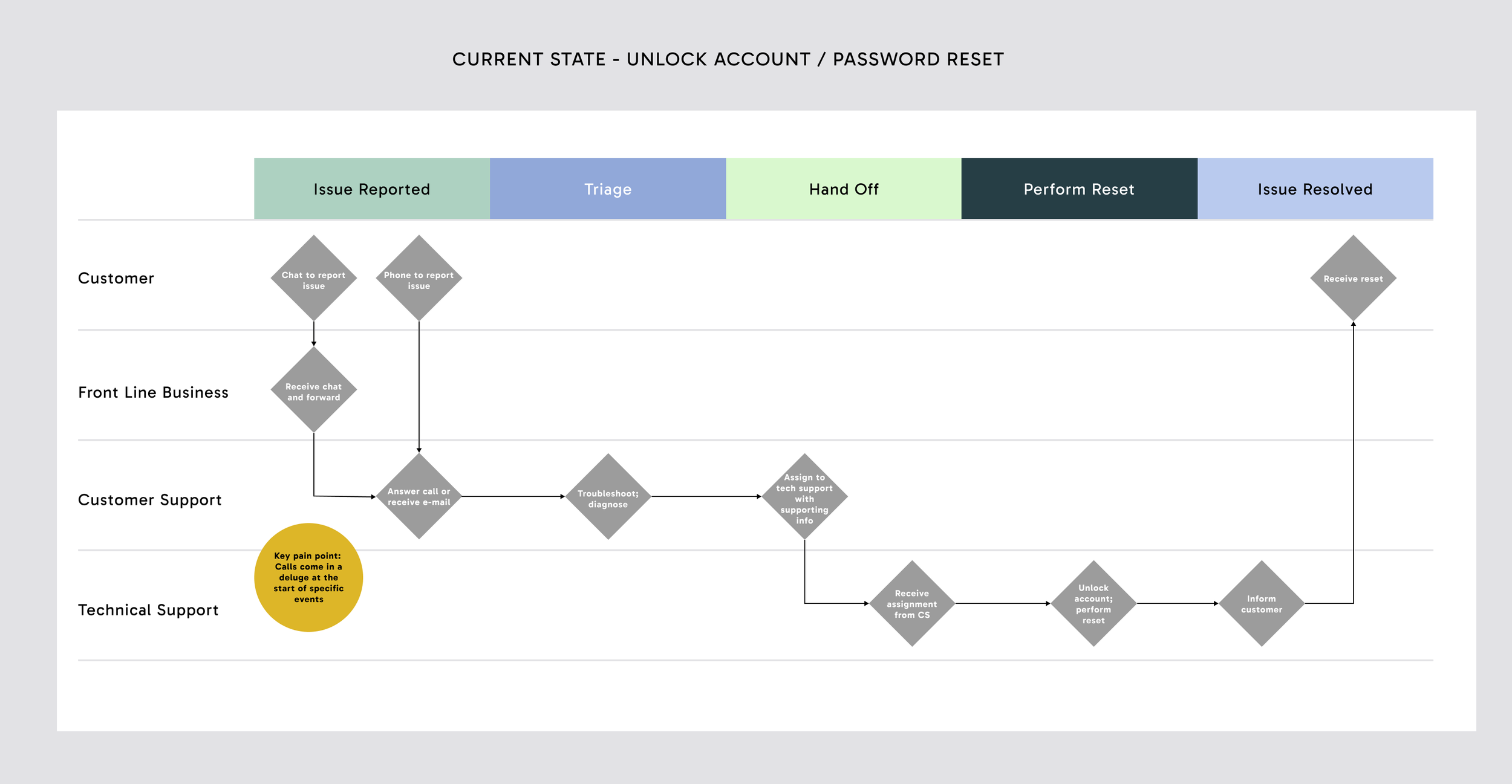
We took the two major issues that came out of our internal workshop — account unlocks and onboarding new users — and captured the current state, along with the major pain points our internal teams experience.
This set us up early on to move toward a possible solution path.
Validate and go deeper with customer interviews
We interviewed 8 organizations who cut across three major customer segments.
Each interview consisted of 16 questions covering onboarding, training, customer support issues and more.
Given the sensitivity of our relationships, the customers we interviewed were carefully vetted and our script went through a number of revisions.
Synthesis
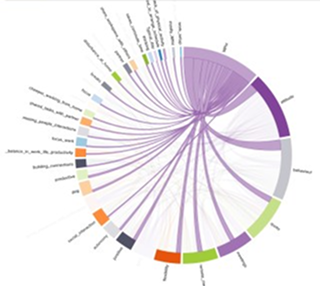
Using Optimal Workshop and their excellent qualitative research tools, such as the chord diagram, we were able to see that customers’ major pain points aligned with our initial theories.
Beyond that, we were able to see that customers who had fewer problems had certain things in common: they conducted internal trainings for our systems and more regularly logged into them.
Recommendations
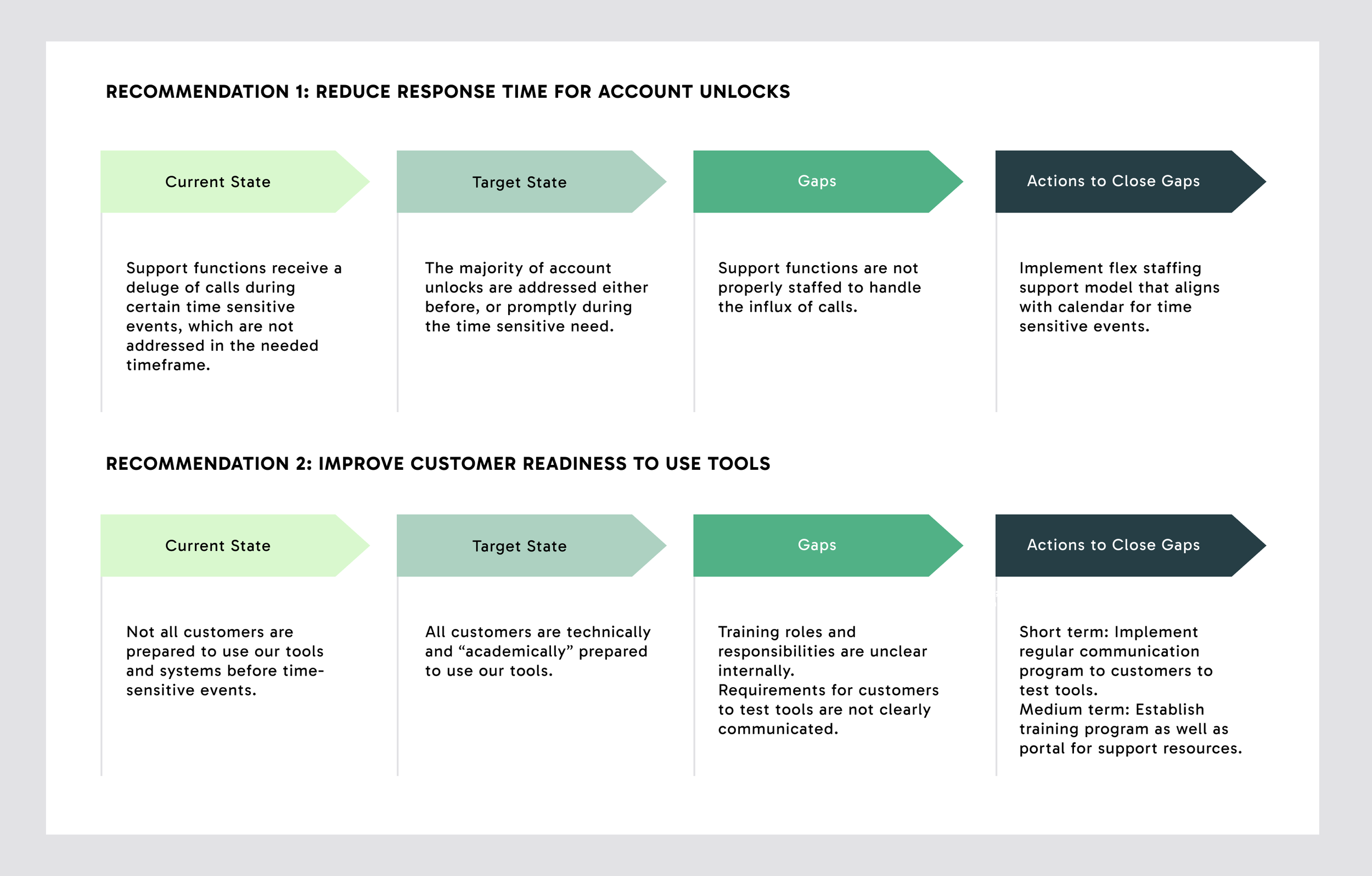
We ultimately made 5 recommendations.
Some of these were near term — such as a direct customer communication program.
Others, like roles & responsibilities and updating tools or adding in automation capabilities, were more long term.
Implement Changes
One of the nice things about being in-house is that you can see a complicated problem space through all the way to resolution.
In the following months after our engagement, a number of our recommendations were implemented and we got to participate and watch them come to fruition.